










Leadership meetings are most useful when they help executives make decisions, remove blockers, and keep strategic priorities moving. They are least useful when they become status recaps, disconnected updates, or a weekly hour where the team talks through information that could have been shared beforehand.
A better leadership meeting starts before the meeting. Owners should provide short updates on priorities, metrics, risks, and blockers in advance. Leaders should arrive with a clear pre-read, review what changed, and use the meeting to decide what needs support, escalation, or follow-up.
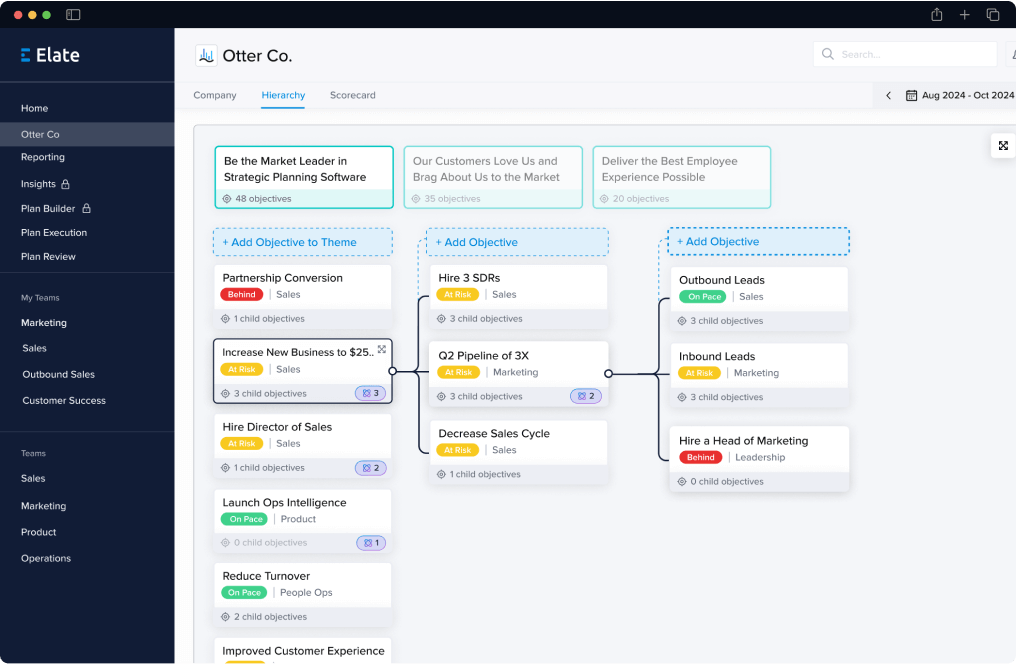
Elate helps leadership teams run this kind of operating review by connecting priorities, owners, updates, KPI context, risks, blockers, and executive-ready reporting. The point is not to add another meeting process. The point is to make the meeting useful enough that owners keep the operating rhythm alive.
How to run leadership meetings that drive execution
The strongest leadership meetings have a simple operating principle: do not spend the meeting collecting status. Collect status before the meeting, then use the meeting to review exceptions, make decisions, and clarify follow-up.
That usually requires five pieces of structure:
- A recurring meeting cadence that leaders protect on the calendar.
- A pre-read that shows the priorities, updates, and risks worth reviewing.
- Clear owners for every priority, initiative, or metric being discussed.
- Status definitions that make “on track,” “at risk,” and “off track” mean the same thing across teams.
- A follow-up loop that captures decisions, blockers, and next steps for the next review.
Without this structure, leadership meetings often drift. The loudest topic gets attention, quieter risks stay hidden, and teams walk away without a clear understanding of what changed or what leadership decided.
Build the pre-read before the meeting
A leadership pre-read should help executives understand what needs attention before they enter the room. It does not need to be long. In most cases, the most useful pre-read shows:
- What changed since the last review.
- Which priorities are on track, at risk, or off track.
- Which metrics need context.
- Which blockers require leadership support.
- Which decisions need to be made in the meeting.
Teams that want this rhythm to scale need a way to build executive-ready strategy reporting before the meeting. Otherwise, the pre-read becomes another manual deck-building exercise that depends on one person chasing updates.
Effective meeting guidelines
Effective leadership meetings are built around consistency. The same operating rules should apply every time, even when the topics change. That consistency helps leaders focus on the substance instead of re-learning the meeting format.
Useful guidelines include:
- Protect the cadence. Moving or canceling the meeting repeatedly signals that the review is optional.
- Require updates before the meeting. Owners should not arrive unprepared to explain progress, risk, or blockers.
- Start with what is at risk. Spend less time on green work and more time on the items that need leadership attention.
- Separate status from decisions. Status belongs in the pre-read. Decisions belong in the meeting.
- Document follow-up. If a blocker, tradeoff, or decision is discussed, capture the owner and next step.
These guidelines apply whether the company runs OKRs, scorecards, EOS, V2MOM, annual priorities, or another operating framework. The framework matters less than whether leaders consistently review progress and act on what they see.
How to structure executive meetings
A strong executive meeting agenda should reflect the way leadership consumes information. Start with the issues that need the most attention, then move into broader updates if time allows.
A practical structure looks like this:
- 1. Review the pre-read and exception summary. Confirm the items that need discussion.
- 2. Start with at-risk priorities. Review blockers, owner commentary, and needed support.
- 3. Review KPI plus narrative. Discuss metrics that need context, not every number on the dashboard.
- 4. Make decisions and tradeoffs. Clarify what should move forward, pause, escalate, or change.
- 5. Confirm follow-up. Assign owners and carry decisions into the next review cycle.
This kind of structure helps leadership teams connect owners, risks, blockers, and follow-up instead of running a meeting that ends with everyone still asking where things stand.
Leadership meeting topics
Leadership meeting topics should tie back to the work leaders can actually influence. Common topics include priority progress, strategic initiatives, KPI movement, budget or capacity constraints, customer or market risk, operational blockers, and cross-functional dependencies.
Not every topic belongs in every meeting. If a topic does not require leadership attention, it may belong in the pre-read, a team-level meeting, or an asynchronous update. The goal is to preserve executive attention for items that need decision-making, support, or escalation.
A useful leadership review also separates metrics from the story behind the metrics. A dashboard can show whether a number moved. The meeting should clarify why it moved, who owns the response, and whether leadership needs to act. For many teams, the operating review is stronger when they can show KPIs, owners, and status in one scorecard.
How to make leadership meetings more effective
To make leadership meetings more effective, remove avoidable status work from the meeting itself. Ask owners for structured updates in advance. Give executives a consistent pre-read. Review at-risk items first. Make decisions explicit. Carry follow-up into the next cadence.
It also helps to define what the meeting is not for. It is not a project standup. It is not a readout of every department’s activity. It is not a place where every dashboard gets walked through line by line. It is a leadership operating review, which means the meeting should make the organization’s most important work easier to understand and act on.
What to review first
Start with the work that needs leadership attention. Green items can usually stay in the pre-read unless they represent a major win or important learning. The meeting should focus on yellow and red work, blockers that require cross-functional support, decisions that have stalled, and tradeoffs that require executive judgment.
This approach protects attention. It also teaches owners what good updates look like. Instead of writing long narrative updates that try to cover everything, owners learn to explain what changed, what is at risk, what help is needed, and what will happen next.
How to keep the cadence alive after the meeting
The meeting is only useful if the follow-up carries into the next cycle. When leaders make a decision, assign a blocker, or ask for more context, that action should not disappear into notes. It should be connected back to the priority, owner, or initiative being reviewed.
A repeatable cadence usually includes a deadline for owner updates, a review window for the pre-read, the leadership meeting itself, and a follow-up check before the next update cycle. This makes the rhythm predictable. Owners know when updates are due. Leaders know when they will review. Strategy and operations teams know when they need to package the information.
Best-fit and not-best-fit boundaries
This kind of leadership meeting structure is a strong fit when the organization has cross-functional priorities, multiple initiative owners, recurring executive reviews, and a real need to connect strategy to execution. It is especially helpful when reporting currently depends on one person chasing updates and rebuilding slides before every meeting.
It is not the right answer if the meeting problem is only scheduling, note-taking, or one-off agenda management. Those problems can often be solved with calendar discipline or a meeting notes tool. The operating review model is most useful when the stakes are strategic: owners, risks, KPI context, blockers, and decisions that need executive attention.
One practical test is whether the same meeting package could be understood by a new executive, a board observer, or a functional leader who missed the last review. If the answer is no, the meeting process probably depends too much on tribal knowledge and not enough on a repeatable operating view.
Where Elate fits
Elate is designed for organizations that have strategic priorities, owners, metrics, and risks to review across a leadership cadence. It helps teams collect updates before the meeting, package those updates into executive-ready reporting, and keep follow-up tied to the priorities being reviewed.
Elate is a strong fit when leadership meetings are spending too much time chasing status, rebuilding reports, or trying to understand which work needs attention. It is not a fit if the problem is only calendar management, meeting notes, or task-level project tracking. Those tools can still stay in place. Elate helps create the strategy execution layer above them, where leaders review what is moving, what is stuck, and what needs a decision.